

traak: practice before the interview really counts
You can have a solid CV, the right skills, and experience that perfectly matches the job.
But once you're in front of the recruiter, another skill comes into play: your ability to tell your story, defend your choices, and clearly express what you can bring.
And contrary to what we sometimes think, being comfortable in an interview is not just a matter of personality.
It can be prepared. It can be practiced. And it can be improved.
Knowing what to say is not always enough
In your head, your answer might seem obvious.
Then the recruiter asks you:
"Tell me about yourself."
"Why you, rather than another candidate?"
"What difficulty have you encountered recently?"
And suddenly, your thoughts get mixed up.
You search for your words, give too many details, or forget the very example that could have made the difference.
An interview requires knowing how to select the essential points, structure your answers, and talk about yourself naturally.
The best time to make mistakes? Before the interview.
We prepare for an exam before taking it. We rehearse a presentation before going on stage.
Yet, many candidates still wait for the real interview to test their answers for the first time.
This is precisely what traak aims to change.
The goal is not to teach you ready-made phrases. It is to allow you to practice enough so that, on the big day, you can focus on the conversation rather than searching for your words.
traak: your oral practice space
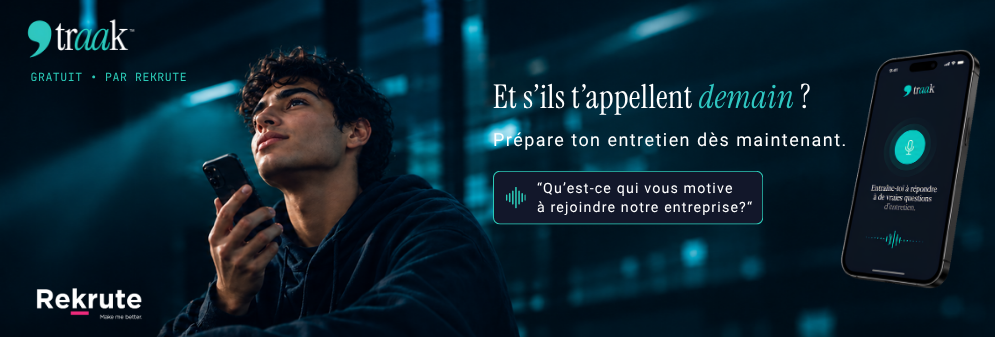
traak is an oral coaching app for job interviews, offered to help candidates prepare.
It works simply:
- You answer out loud to real recruiter questions.
- An AI analyzes your answer based on concrete criteria.
- You discover what already works.
- You identify areas for improvement.
- Then you start again until you have a clearer and more convincing answer.
You can hesitate, rephrase a sentence, try a different way of answering.
Here, making mistakes is part of the practice.
Practice to replace stress with reflexes
Nerves don't always disappear completely.
But when you've answered a question several times, found your best example, and learned to structure your thoughts, you approach the interview differently.
You're not reciting.
You simply know better where you want to go with your answer.
And this preparation can help you be more natural, more precise, and above all more confident when a recruiter is actually in front of you.
The key takeaway
A CV can convince a recruiter to meet you.
But then, it's up to you to bring that journey to life.
No pressure. No judgment. Just the freedom to try, adjust, and start over.
traak: Follow your path. One voice at a time.
Read also: These candidates use AI to prepare their interviews: here's how they do it
