The silence after an application: what you really need to understand

Title: The silence after an application: what you really need to understand
No response after an application?
What this (really) means... and how to react
You applied for a job that was a perfect fit for you.
Resume sent, profile updated, motivation intact.
Then... radio silence.
This situation is frustrating, sometimes discouraging. However, not getting a response is not necessarily a rejection, nor a judgment on your profile.
Why recruiters don't always respond
In most cases, silence is explained by very concrete reasons:
A high volume of applications to process,
Recruitment processes longer than expected,
Changing internal priorities,
An already well-advanced shortlist.
This does not call your value or your potential into question.
What silence does NOT mean
"My profile isn't interesting"
"I'm not good enough"
"I missed something"
In reality, a recruiter can find a profile relevant without being able to follow up immediately.
Should you follow up? Yes... but smartly
Following up can be useful, provided you do it in moderation:
Wait at least 10 to 15 days,
Remain courteous and professional,
Show your interest without insisting.
A well-worded follow-up shows motivation and seriousness, without unnecessary pressure.
Follow up your application, simply from ReKrute
On ReKrute, following up on an application is also a feature integrated into the platform.
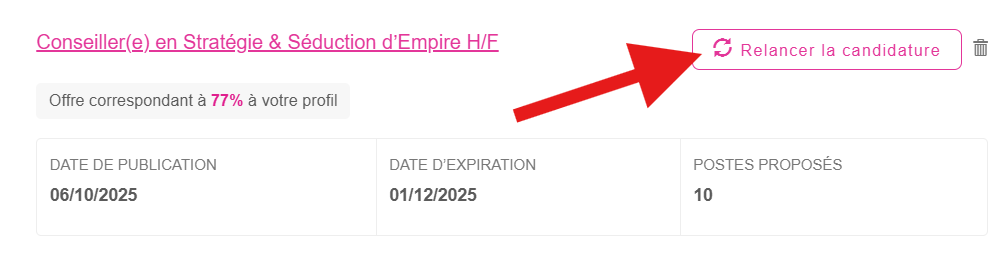
When you have already applied for a job, you can track the progress of your application from your candidate space and, if necessary, use the button "Follow up application".
This follow-up is visible to the recruiter and takes place in a professional context, without having to find an email address or send an awkward message.
It's a simple way to:
Show that your interest in the position is still there,
Remind them at the right time, without insisting,
Gain visibility, especially when the recruiter is managing many applications.
A well-used follow-up can sometimes be enough to put your profile back on top of the pile.
Keep moving forward, even without a response
The most common mistake is to put your entire job search on hold while waiting for a response.
The right approach is to:
Continue applying for targeted jobs,
Refine your resume and positioning,
Multiply opportunities, without spreading yourself too thin.
Each application is a step, not a verdict.
Turn waiting into an advantage
The waiting time can also be used to:
Better understand your strengths,
Clarify the type of position you are looking for,
Adjust your professional pitch.
An effective job search relies as much on patience as on strategy.
To remember
Silence is not failure.
A well-done follow-up can make the difference.
Continuing to move forward is the best response.