

Call Centers: The New Slaves
17 December 2008
Read by 2476 persons
A reporter from "actuel" magazine got hired at a call center in Rabat with working conditions far below standards: no fixed salary, horrible work environment, telephone scams, etc. In a booming economic sector (25,000 workers, 4 billion in turnover in 2009), it's interesting to note that serious structures that somewhat respect human dignity exist alongside small structures whose sole objective is to ride the trend and make as much money as possible, while blatantly flouting the labor code. Between the two, there's a wide range of nuances.
Find the exclusive interview with Drik Van Der Leuuwen, CEO of Webhelp Group Morocco, who believes that: "we don't need a collective agreement", as well as Leila Nassimi, a union representative for whom "the investor king must not become a tyrant"…
Excerpt:
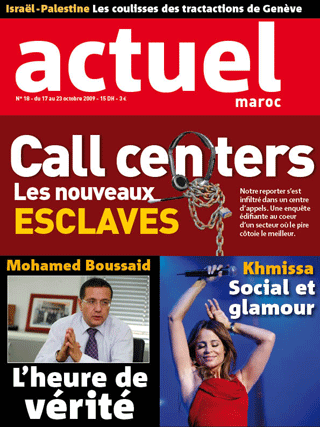
Our journalist from "actuel" got hired at a call center with far below standard conditions. The booming economic sector in Morocco is far from being a social model…
My name: "Etienne". My mission: to sell, or rather to peddle "wellness products", mainly to Swiss grandmas. "Hello, I'm Etienne from Im concept* in Lausanne, a specialist in natural products for well-being and health." This first day at Call technology* is particularly stressful: I listen to the calls made by my six colleagues "Joel", "Camille", "Armand", "Gloria", "Christine", "Yves" and "Barbara". I also try to learn as much as possible from a script given to me by Sophie, the team leader. Goal: to quickly familiarize myself with the product and the modus operandi of the calls to achieve sales targets. A first team, which I am part of, is assigned to the telesales of the "quietude" program: a cure of natural (sic!) capsules based on medicinal plants and magnesium. Gloria and Barbara are working on an insurance sales project.
First bad news: there is no fixed or minimum salary. At 120 dirhams per sale, I have a "reasonable" objective, they tell me, of 30 sales per month. With that, I should "easily" earn around 3,500 dirhams per month and "progress quickly", assures Sophie, who was rather affable during the interview a few days earlier. In addition, I have to accept an unpaid "internship" (actually work) period of 15 days.
My colleagues quickly confirm that if I don't sell, I won't be paid. But that they are all there to help me. It must be admitted that the atmosphere is friendly and the team is close-knit. I learn that here we have the right to speak Darija among ourselves, to take as many breaks as we want to go to the toilet for example. This is not the case in other call centers. These are mainly the reasons that pushed these young people, average age twenty-five, to try the Call technology adventure. They are all students and work to pay for their studies or to make some pocket money.
Excerpt:
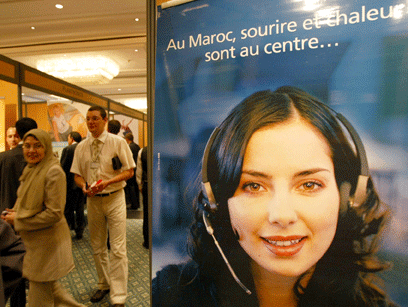
You are the first employee of a call center to have created a union representation. What motivated you to do so?
I am 47 years old and have 30 years of professional experience. I was a civil servant in a municipality for several years before becoming interested in phone work as a freelancer. I ended up joining a large call center group in Casablanca in 2004. I realized that there were many violations of the labor code: shift system, work on public holidays, etc. In 2005, I created the first union office. At first, it was well received. Today, the employees who dared to violate the omertà have been punished.
Infiltration, testimonies from telemarketers with different experiences, a review of the main growth driver of offshoring.... An exclusive investigation this week in "actuel".
On newsstands since Saturday, October 17, 2009.
Find the exclusive interview with Drik Van Der Leuuwen, CEO of Webhelp Group Morocco, who believes that: "we don't need a collective agreement", as well as Leila Nassimi, a union representative for whom "the investor king must not become a tyrant"…
Excerpt:
Our journalist from "actuel" got hired at a call center with far below standard conditions. The booming economic sector in Morocco is far from being a social model…
My name: "Etienne". My mission: to sell, or rather to peddle "wellness products", mainly to Swiss grandmas. "Hello, I'm Etienne from Im concept* in Lausanne, a specialist in natural products for well-being and health." This first day at Call technology* is particularly stressful: I listen to the calls made by my six colleagues "Joel", "Camille", "Armand", "Gloria", "Christine", "Yves" and "Barbara". I also try to learn as much as possible from a script given to me by Sophie, the team leader. Goal: to quickly familiarize myself with the product and the modus operandi of the calls to achieve sales targets. A first team, which I am part of, is assigned to the telesales of the "quietude" program: a cure of natural (sic!) capsules based on medicinal plants and magnesium. Gloria and Barbara are working on an insurance sales project.
First bad news: there is no fixed or minimum salary. At 120 dirhams per sale, I have a "reasonable" objective, they tell me, of 30 sales per month. With that, I should "easily" earn around 3,500 dirhams per month and "progress quickly", assures Sophie, who was rather affable during the interview a few days earlier. In addition, I have to accept an unpaid "internship" (actually work) period of 15 days.
My colleagues quickly confirm that if I don't sell, I won't be paid. But that they are all there to help me. It must be admitted that the atmosphere is friendly and the team is close-knit. I learn that here we have the right to speak Darija among ourselves, to take as many breaks as we want to go to the toilet for example. This is not the case in other call centers. These are mainly the reasons that pushed these young people, average age twenty-five, to try the Call technology adventure. They are all students and work to pay for their studies or to make some pocket money.
Excerpt:
You are the first employee of a call center to have created a union representation. What motivated you to do so?
I am 47 years old and have 30 years of professional experience. I was a civil servant in a municipality for several years before becoming interested in phone work as a freelancer. I ended up joining a large call center group in Casablanca in 2004. I realized that there were many violations of the labor code: shift system, work on public holidays, etc. In 2005, I created the first union office. At first, it was well received. Today, the employees who dared to violate the omertà have been punished.
Infiltration, testimonies from telemarketers with different experiences, a review of the main growth driver of offshoring.... An exclusive investigation this week in "actuel".
On newsstands since Saturday, October 17, 2009.
